
Ozone and Water Vapour across the Tropopause
The tropopause region constitutes an exceptionally sensitive region, where changes in composition have a large efficiency for forcing surface climate in particular for ozone and water vapour.
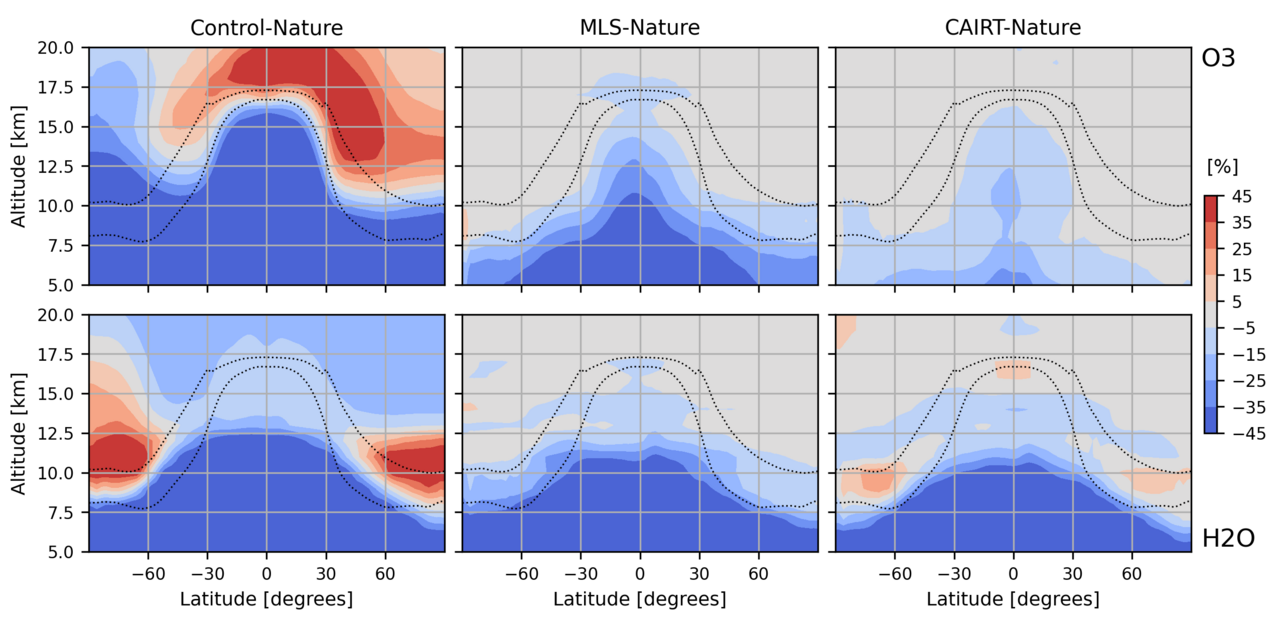
 In a region that is essential to the Earth’s radiative balance, resolving the strong vertical gradients and tracer fluxes across the tropopause provides a means to attributing changes in the upper troposphere and lower stratosphere (UTLS) composition to changes in atmospheric chemistry and circulation. The capability of CAIRT to reproduce the strong gradients and features associated with stratosphere-to-troposphere (STE) exchange has been evaluated on ozone with an Observing System Simulation Experiment (OSSE) as part of the science impact studies. OSSEs evaluate the added value of potential instrument(s) using simulated observations and data assimilation.
A nature run (NR) defines the true state of the atmosphere from which observations are simulated and a control run (CR) provides the baseline atmospheric state. An assimilation run (AR) of the simulated observations allow quantifying the added value of the new instrument when compared to the NR and CR.
Results from the Observing System Simulation Experiment (OSSE) demonstrate that CAIRT would be able to constrain ozone (top row) and water vapour (bottom row) in the critical upper troposphere and lower stratosphere as good or even better than the Microwave Limb Sounder (MLS). MLS is considered the gold standard for these observations but soon to expire. The dashed lines represent the thickness of the tropopause during the specified time frame from October 2021 to Febuary 2022 (credits: BIRA-IASB – Q. Errera)."
In order to further improve the performances of CAIRT in the UTLS, spatially and temporally co-registered measurements by IASI-NG and Sentinel 5 (S5) on board MetOp-SG-A, flying in loose formation with CAIRT, can be exploited.
Proof-of-concept performance simulations of 2D (along-track and vertical) synergistic retrievals for ozone indicate noteworthy improvements over single-instrument products (lower uncertainties or biases, better resolution), together with vertical extension of the products to the surface-level. The impact of such improvements is greatest in the UTLS, a key region for CAIRT scientific objectives and notably challenging for space-based remote sounding.
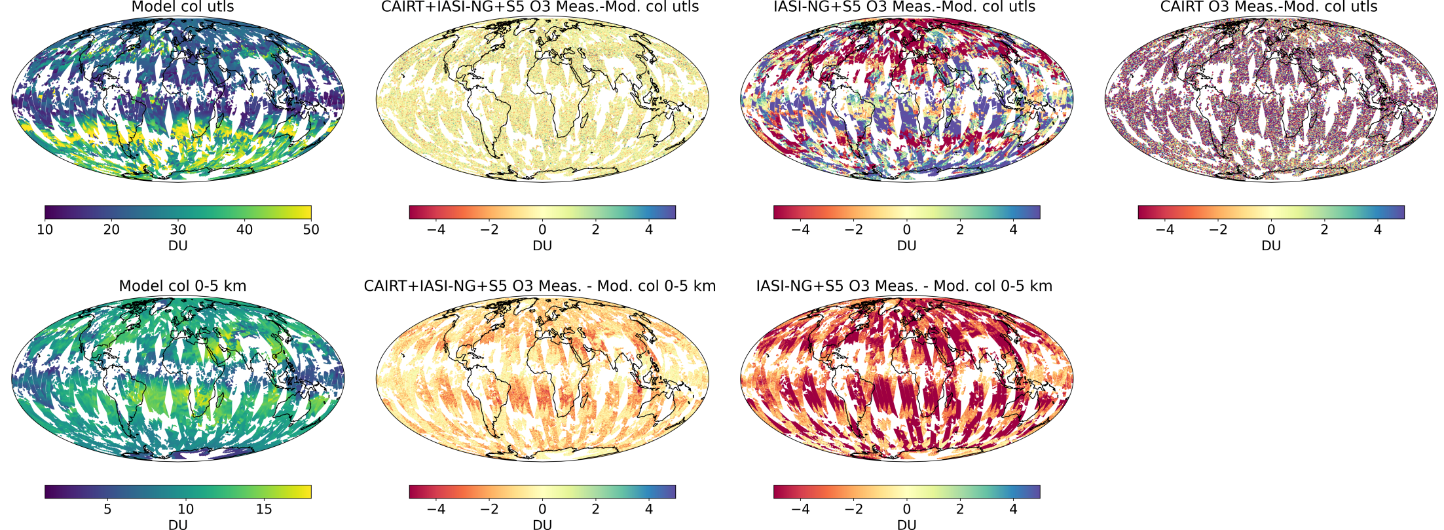
The top row shows the absolute error for a retrieved UTLS ozone partial column (from tropopause – 3 km to tropopause + 3 km), with evident improvements over individual CAIRT and IASI-NG+S5 data products. These improvements will benefit UTLS studies and will enable better characterisation of stratosphere-troposphere exchange. In addition, the synergistic retrievals of nadir and limb products significantly improve the partial column of lower tropospheric ozone compared to IASI-NG+S5 alone (bottom row), highlighting the contribution that limb sounding can bring when combined with the nadir sounding for observations in the troposphere.